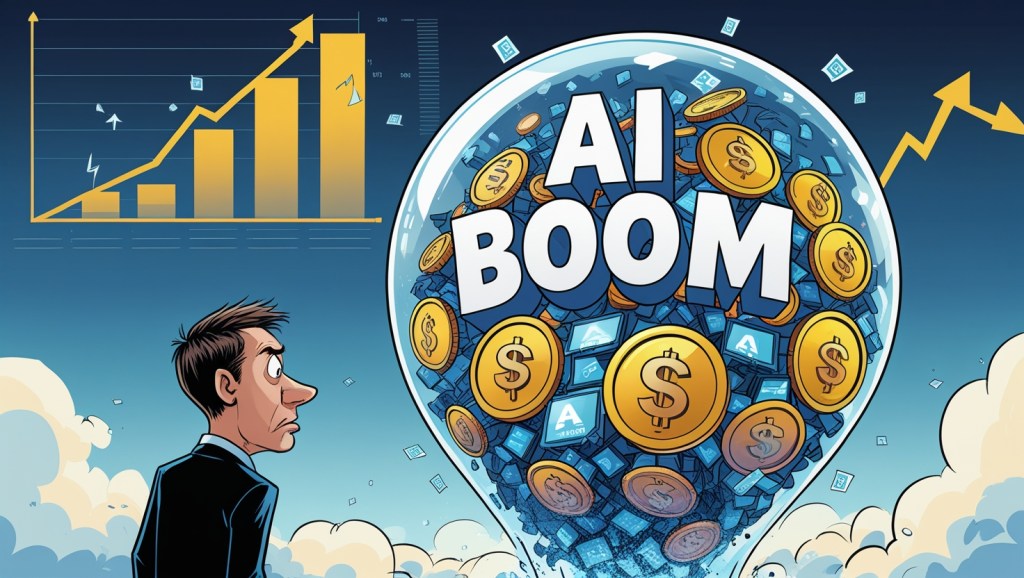
The artificial intelligence surge of 2025 has captured investor attention, but beneath the hype lies a growing concern: is the AI boom morphing into a dangerous bubble?
With global AI investments already surpassing $560 billion and megacap tech companies like Microsoft, Meta, and Nvidia trading at sky-high valuations, the gap between promise and productivity is becoming increasingly clear. In this article, we break down what leading economists are warning about — and how it could affect the broader economy if this trend unravels.
1. AI Investment Surge Meets Productivity Stagnation
While AI spending is skyrocketing, recent research suggests the return on investment is questionable. A study by MIT revealed that 95% of enterprises adopting generative AI in 2025 have not reported any measurable improvement in profitability.
At the same time, projections estimate that AI infrastructure spending could reach $3 trillion by 2029. That kind of rapid acceleration without real productivity raises obvious red flags — especially when the economic fundamentals are not keeping pace.
2. Expert Warnings: Are Valuations Detaching from Reality?
Some economists are sounding the alarm. Torsten Slok, chief economist at Apollo Global Management, stated that current valuations of AI-related stocks may already exceed the levels seen during the dot-com bubble of the late 1990s.
Even OpenAI CEO Sam Altman recently admitted that investor optimism surrounding AI might be “overexcited,” pointing out eerie similarities with historical tech bubbles.
3. A Pre-Bubble Phase? Overinvestment and Structural Risk
Economic theorist Carlota Perez refers to this period as the “installation phase” — a phase common to every technological revolution, marked by speculative capital, overcapacity, and fragile financial structures. Her view: AI is going through the same cycle electricity, automobiles, and the internet once did.
The danger is that a crash may arrive before real innovation scales to deliver long-term returns. For now, the productivity benefits of AI remain more promise than reality.
4. What Happens If the Bubble Bursts?
If AI speculation collapses, the effects won’t be limited to tech investors. Some economists argue that AI-related investment has acted as an informal stimulus, propping up markets and shielding the U.S. economy from broader weakness.
Should that support disappear, it could trigger a widespread downturn, affecting jobs, household spending, and market stability across sectors.
5. Contrarian Perspective: Is a Bubble Inevitable?
Not all analysts agree that we’re heading for a crash. Firms like UBS point out that today’s AI megacaps are more profitable than dot-com startups ever were, with stronger earnings and more grounded valuations.
Still, even the optimists advise caution — recommending diversified portfolios and long-term thinking rather than blind speculation.
Conclusion: Caution Over Panic
The AI boom is real, but so are the risks of overhype. As with all tech revolutions, early optimism often outpaces the actual economic transformation. While a full-blown bubble isn’t guaranteed, signs of overvaluation and weak returns shouldn’t be ignored.
For now, the smartest approach may be to stay informed, invest selectively, and watch closely as AI continues to reshape the economy — one breakthrough at a time.
👉 Looking to invest in real-world tech that actually delivers?
Check out our curated list of budget-friendly Amazon gadgets that pay off in productivity, comfort, and cost savings — no hype, just results.
References
- The Atlantic, Just How Bad Would an AI Bubble Be?, 2025.
- Financial Times, Brace for a Crash Before the Golden Age of AI, 2025.
- MoneyWeek, Could the AI Megacap Bubble Burst?, 2025.
- WebProNews, AI Stock Boom Hits Dot-Com Heights, 2025.
- Yale/MIT Research, AI Deployment and Return on Investment, 2025.
- UBS, AI Stocks: Bubble or Buy Opportunity?, 2025.
 Smart Money Tech