The market has been falling again.
Tech stocks are volatile. AI names are under pressure. Headlines feel heavier. And the same question keeps resurfacing:
Are we entering a crisis?
It’s a fair question. But before jumping to conclusions, it helps to define what a crisis actually looks like — and whether today’s market fits that description.
What a Real Crisis Looks Like
Historically, financial crises share certain traits.
In 2008, credit markets froze. Major banks collapsed. Liquidity evaporated. The Federal Reserve intervened aggressively to prevent systemic failure.
In early 2020, markets plunged amid sudden global shutdowns. Economic activity stalled almost overnight. Emergency monetary stimulus followed immediately.
Crises typically involve:
- A breakdown in credit markets
- Rapid unemployment spikes
- Forced deleveraging
- Central bank emergency action
- Structural instability in the financial system
The key element is systemic stress — not just falling stock prices.
What We’re Seeing Now
In early 2026, markets are undeniably volatile. Growth stocks are being repriced. AI-related companies are facing more scrutiny. Forward guidance is moving stocks more than past results.
But the broader financial system does not currently show classic signs of distress.
According to recent reporting from Reuters, Global Markets Coverage (February 2026), equity volatility has increased, particularly in technology sectors, but credit markets remain functional and liquidity conditions stable.
Spreads in corporate bond markets — while fluctuating — have not widened in a way that signals systemic panic. The Federal Reserve has not signaled emergency intervention. Banking stress indicators remain contained.
What we are seeing looks more like adjustment than collapse.
The Role of Interest Rates and AI Expectations
Two forces are shaping market behavior in 2026:
1️⃣ Higher-for-Longer Interest Rates
While rate cuts are widely discussed, policy rates remain elevated compared to the ultra-low environment of the 2010s. Higher capital costs naturally pressure high-growth stocks and long-duration assets.
According to the Federal Reserve’s Monetary Policy Reports (2025–2026), policymakers remain cautious about premature easing, emphasizing inflation management and labor market resilience.
2️⃣ AI Recalibration
The AI rally of the past two years expanded valuations quickly. Now investors are shifting from enthusiasm to evaluation. Markets are demanding proof of sustainable profitability rather than future promises.
As noted in Bloomberg Intelligence, AI Investment Outlook 2026, capital expenditures in AI infrastructure remain historically high, increasing pressure on margins and execution.
Neither of these dynamics automatically signals crisis. They signal maturity.
The Quiet Risk Beneath the Surface
That said, complacency would also be misguided.
There are legitimate risks in the current environment:
- Elevated corporate debt levels
- Slower global growth
- Geopolitical uncertainty
- Persistent fiscal deficits
According to analysis from JPMorgan Global Strategy (2026 Outlook Report), markets are entering a phase where resilience depends heavily on earnings stability and disciplined capital allocation.
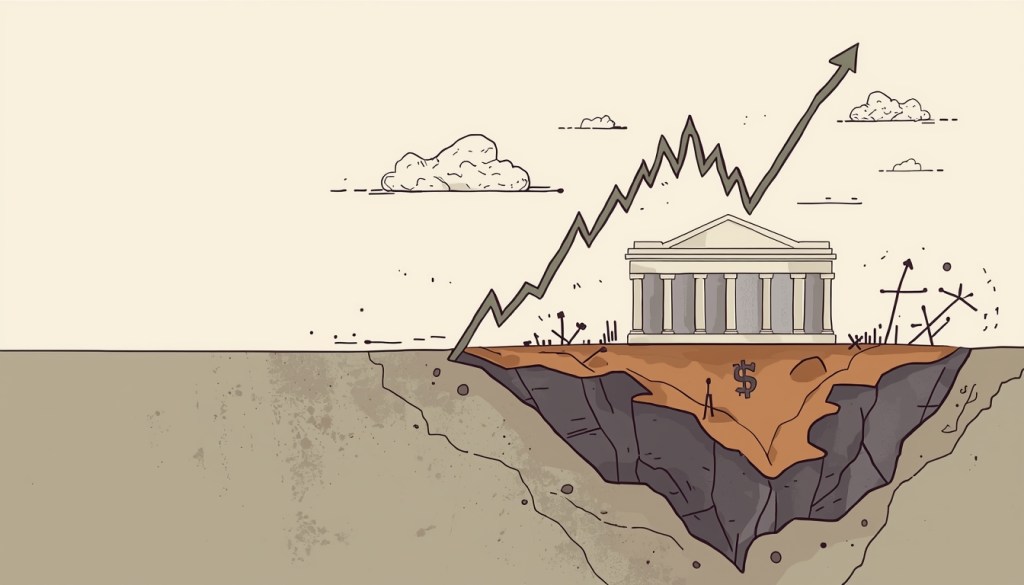
This is not systemic breakdown. But it is a more fragile equilibrium.
Markets can transition from adjustment to stress if multiple pressures converge. That hasn’t happened — but it remains a possibility in any late-cycle environment.
What the Market Itself Is Signaling
Markets tend to price expectations before outcomes.
Current volatility suggests investors are reassessing optimism — not fleeing the system. Risk appetite has narrowed, not disappeared.
Defensive sectors have gained relative strength. Bond demand remains steady. Liquidity is present.
These signals point toward caution, not collapse.
Conclusion: Crisis — or the End of Easy Gains?
It may not be accurate to say we are entering a crisis.
But it may be accurate to say we are exiting an era of effortless momentum.
The past few years rewarded narrative, growth projections, and capital expansion. The current phase appears to reward discipline, profitability, and balance sheet strength.
Markets feel uncomfortable not because they are breaking — but because they are adjusting.
The more difficult question may not be whether we are in a crisis.
It may be whether investors are prepared for a market that no longer rises simply because expectations are optimistic.
In 2026, volatility may not signal collapse.
It may signal accountability.
References
- Reuters, Global Markets Coverage: Volatility rises in tech as investors reassess growth outlook, February 2026.
- Federal Reserve, Monetary Policy Report, 2025–2026.
- Bloomberg Intelligence, AI Investment and Capital Expenditure Outlook 2026, 2026.
- JPMorgan, Global Strategy Outlook 2026, 2026.
- Federal Reserve Bank of New York, Financial Stability Indicators Report, 2026.
 Smart Money Tech